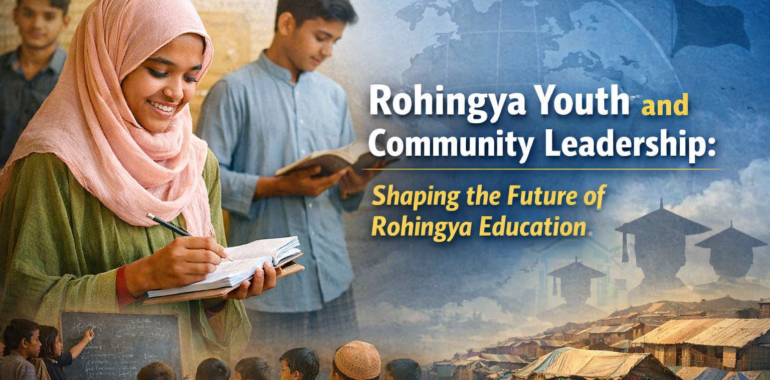
Today, as the global education community marks the International Day of Education, the Rohingya Centre of the United Kingdom (RCUK) joins this moment to reaffirm the central role of youth and communities in advancing inclusive, equitable, and quality education particularly in contexts of displacement, statelessness, and prolonged exclusion.
For the Rohingya people, access to education has been systematically denied for generations. Restrictions on movement, language, accreditation, and progression to higher education have created one of the most severe and protracted education crises in the world. Despite these conditions, Rohingya communities have sustained learning through community-led initiatives, often in the absence of formal state-supported systems.
There could not be a more fitting moment to place Rohingya youth and community leadership at the centre of education decision making. For the first time, Rohingya communities across refugee camps, host countries, and the diaspora are collectively working towards a Rohingya Education System. This is a community-led, rights-based framework designed to ensure continuity, quality, cultural relevance, and future recognition for Rohingya learners. This marks a significant shift from fragmented and temporary responses towards a coherent, long-term education vision rooted in community ownership.
This moment is also forward-looking. As the world enters the final phase of SDG 4 and begins shaping a new global education agenda, the lived experiences of stateless and displaced communities must inform future policy and practice. Education systems developed without the meaningful participation of affected communities risk reinforcing exclusion. Education systems built collaboratively with youth and communities can foster dignity, agency, and sustainable impact.
Education systems are meaningful when Rohingya youth and communities shape them
Rohingya youth leadership has grown steadily across community learning centres, refugee camps, diaspora organisations, and digital platforms. Young people are serving as educators, curriculum developers, mentors, advocates, and organisers. They are advancing inclusion, accountability, and quality within their communities, often with limited resources and institutional support.
Education is fundamentally about children and young people and their futures. For Rohingya children and young people, it is also about identity, hope, and justice. It is therefore essential that they contribute directly to the decisions that shape their learning pathways. Community-led education initiatives have long been the backbone of Rohingya education. The development of a Rohingya Education System seeks to strengthen these efforts through shared standards, coordination, and long-term vision while remaining firmly grounded in community leadership.
Yet participation remains uneven. While Rohingya youth and community actors are increasingly consulted, their engagement is rarely embedded across education design, implementation, monitoring, and evaluation. As a result, their contributions often remain informal, short-term, or disconnected from formal decision-making structures.
Encouragingly, recognition of community-led education systems is growing, particularly in displacement contexts. Education stakeholders are increasingly acknowledging the importance of local leadership in areas such as curriculum relevance, language of instruction, psychosocial well-being, inclusion, and access to secondary and higher education pathways.
When Rohingya youth and communities lead alongside education partners, the potential for inclusive, high-quality education systems built on trust, intergenerational respect, and shared responsibility can be fully realised.
Meaningful youth engagement and community leadership remain aspirational
While youth and community leadership are essential to Rohingya education, they continue to be treated as supplementary rather than structural. The priorities ahead are clear: embedding Rohingya representation within education governance; strengthening community-led systems; investing in enabling environments; and ensuring that youth and community voices shape education from vision through to evaluation.
Governments, international organisations, and education partners committed to Rohingya education should prioritise the following actions:
- Formally recognise and support community-led education systems, including the Rohingya Education System, as legitimate and essential education pathways.
- Embed Rohingya youth and community participation within education decision-making processes, with clear roles, safeguarding, adequate time, and transparent feedback mechanisms.
- Engage Rohingya-led organisations not only in programme design, but also in implementation, monitoring, evaluation, and quality assurance.
- Invest in institutional capacity-building, including teacher training, leadership development, and education governance structures.
- Support accredited and future-oriented education pathways, including access to secondary and higher education, to ensure continuity and long-term opportunity for Rohingya learners.
A call to strengthen community-led Rohingya education
The development of a Rohingya Education System reflects decades of community resilience and a collective determination to move beyond fragmented and temporary solutions. Rohingya communities are not starting from zero, they are formalising, strengthening, and sustaining education systems they have long built and maintained under extremely challenging conditions.
As the international community shapes the future of education beyond SDG 4, Rohingya voices must be central to that process, not as beneficiaries, but as partners and leaders. Education systems designed for Rohingya communities will remain insufficient. Education systems built with Rohingya youth and communities can transform futures.
On this International Day of Education, RCUK calls for renewed commitment to community-led and youth-led education so that Rohingya children and young people are not only learners, but architects of their own education system and future.