Public Statement – 4 January 2026
Today, on 4 January 1948, Burma (now Myanmar) gained independence from British colonial rule, marking a historic moment of sovereignty. For many communities, this day represents freedom and the promise of a nation built on equality and inclusion. For the Rohingya people of Arakan (now Rakhine State), however, the anniversary carries a more complex and serious significance.
Arakan wasinvaded and forcibly incorporated under Burmese rule in 1784, and while the region later came under British colonisation in the late 19th century, the Rohingya remained integral to the social, economic, and cultural fabric of the land. The Rohingya, whose name derives from the ancient region of Rohang (now Arakan/Rakhine State), have lived in the region for centuries and are indigenous to the land. During the early post-independence period, Rohingya and most Muslims were recognised as citizens of Burma under the 1948 Constitution and civilian administration, enjoying full rights and participating in political, social, and economic life.
This status changed drastically following the 2 March 1962 military coup led by General Ne Win. Subsequent constitutions and laws, including the 1974 Constitution and the 1982 Citizenship Act, systematically excluded Rohingya from recognition, defining citizenship in ways that rendered most Rohingya stateless. Denied citizenship, they faced restrictions on movement, education, employment, marriage, and access to basic rights, while state policies increasingly promoted discrimination and marginalisation.
The consequences of decades of exclusion and persecution culminated in mass atrocities and displacement, particularly during the 2012 communal violence and the 2017 military-led operations, which amounted to genocide, forcing hundreds of thousands into Bangladesh and leaving hundreds of thousands internally displaced. Despite repeated warnings from international bodies, including the UN Human Rights Council, Rohingya continue to face denial of basic rights, restricted access to healthcare and education, and exclusion from their ancestral homeland.
For Rohingya, Myanmar’s independence remains incomplete and unfulfilled. True independence must be measured not only by sovereignty but by the recognition, inclusion, and dignity of all peoples, regardless of ethnicity or religion.
On this 78th anniversary, the Rohingya Centre of the United Kingdom (RCUK) reaffirms its commitment to peaceful advocacy, international cooperation, and accountability under international law. We call on the international community to acknowledge the ongoing exclusion of Rohingya from their homeland and to support justice, protection, and a future in which Rohingya can return safely, live with recognised identity, and enjoy their birth rights in Arakan as indigenous people.
Independence that excludes an entire people cannot be celebrated fully. The Rohingya struggle remains a reminder of the work that remains ensuring dignity, inclusion, and justice for all in Myanmar.
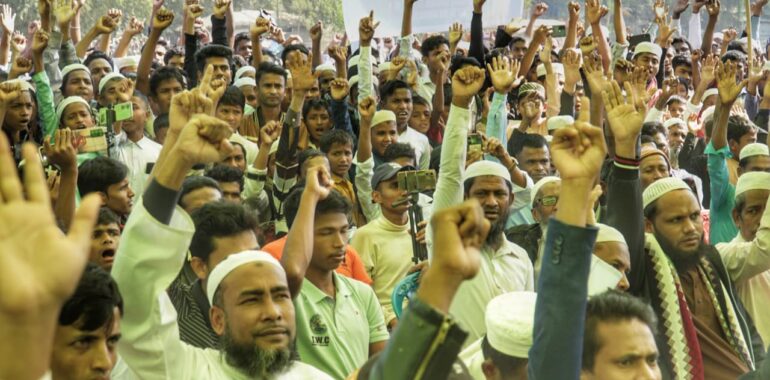
Echoing this reflection, the United Council of Rohingya (UCR) organised a Myanmar Independence Day Program at Refugee Camp in Bangladesh on 4 January 2026. The program aims to reflect on the historical significance of Myanmar’s independence, promote awareness, and foster unity and dialogue within the community.